Air Purifier vs Dehumidifier: Which One Do You Need?

Updated: 10 hours ago
Reviewed by Our Editors at Zenda Guide
Our content follows our Editorial Standards and is evaluated using the Zenda Lab Protocol.

But these two devices solve very different indoor air issues.
An air purifier filters airborne particles like dust, pollen, pet dander, smoke, and, depending on the filter, some odors or gases. A dehumidifier removes excess moisture from the air, which can help with damp rooms, condensation, musty smells, and humidity-related mold risk.
The key is choosing based on the root problem — not just the product category.
In this guide, we’ll help you decide whether you need an air purifier, a dehumidifier, or both, based on what you’re actually noticing in your room.
Quick Answer: Air Purifier vs Dehumidifier
An air purifier is usually the better choice if your main concern is dust, pollen, pet dander, smoke, or airborne particles.
A dehumidifier is usually the better choice if your main concern is damp air, condensation, musty smells, basement humidity, or mold-prone spaces.
You may need both if the room has excess moisture and airborne irritants. For example, a damp basement with a musty smell may need a dehumidifier first, while an air purifier can help support filtration once the moisture issue is being controlled.
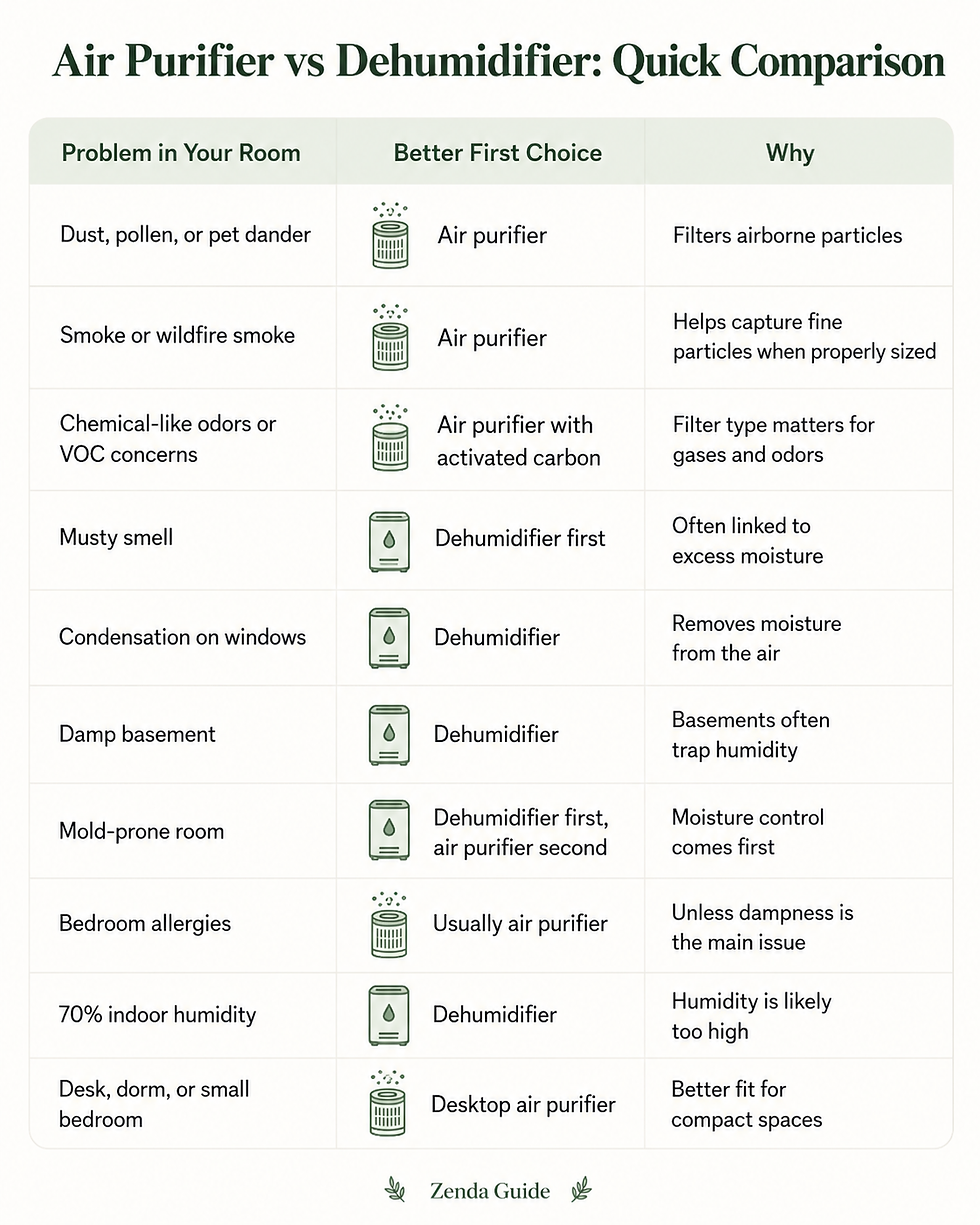
Zenda Takeaway: If the room feels dusty, smoky, or full of pet dander, start with filtration. If it feels damp, sticky, or musty, start with moisture control.
For product-specific help, you can also compare our guides to the best dehumidifiers, best non-toxic air purifiers, best desktop air purifiers, and best air purifiers for mold.
What’s the Difference Between an Air Purifier and a Dehumidifier?
The main difference is simple:
An air purifier cleans the air. A dehumidifier dries the air.
An air purifier pulls air through filters to capture particles like dust, pollen, pet dander, smoke, and other airborne matter. Some air purifiers also include activated carbon filters, which can help with certain odors and gases.
A dehumidifier works differently. It pulls moisture from the air and collects it in a tank or drains it through a hose. It does not clean the air in the same way an air purifier does.
Air purifier
What It Does: Filters airborne particles and, with the right filter, some odors or gases
What It Does Not Do: Does not remove humidity
Dehumidifier
What It Does: Removes excess moisture from indoor air
What It Does Not Do: Does not filter dust, pollen, smoke, or pet dander like an air purifier
So, if you’re wondering whether an air purifier is the same as a dehumidifier, the answer is no. They may both improve how a room feels, but they solve different problems.
An air purifier is about airborne particles.
A dehumidifier is about moisture.
That distinction matters because choosing the wrong device can leave the real issue untouched. If the room smells musty because humidity is high, an air purifier may make the air feel fresher for a while, but it will not remove the dampness that caused the smell. If the room is dusty or full of pet dander, a dehumidifier may make the air less humid, but it will not filter those particles from the air.
When an Air Purifier Is the Better Choice

An air purifier is usually the better first choice when the problem is related to particles or pollutants moving through the air.
This can include:
dust
pollen
pet dander
smoke
wildfire smoke
airborne mold spores
some odors, depending on the filter type
general stale air in a closed room
Air purifiers are especially useful when you can identify the issue as something floating in the air rather than something caused by excess moisture.
For example, if your bedroom gets dusty quickly, your pets sleep nearby, or smoke from outside enters your home, an air purifier may be the more relevant tool. The right model can help reduce airborne particles as air circulates through the filter.
Air Purifiers and Filter Type Matter
Not every air purifier solves the same problem.
A purifier with a HEPA filter is designed to capture particles such as dust, pollen, pet dander, and smoke particles. A purifier with activated carbon is more relevant when your concern includes odors, cooking smells, smoke smells, or some VOC-related concerns.
Because these filters solve different problems, it helps to understand the difference before choosing a purifier. Our guide to HEPA vs Carbon Air Filters explains what each filter type removes, where they overlap, and when you may want a purifier that includes both.
That distinction matters because a basic particle filter may not be enough if your main concern is chemical-like smells or gases.
Zenda Takeaway: Choose an air purifier when the issue is in the air itself — dust, smoke, dander, pollen, or particles you want to filter from the room.
For a deeper product path, explore our guide to the best non-toxic air purifiers. For compact spaces like desks, dorms, or small bedrooms, our best desktop air purifiers guide may be a better starting point.
When a Dehumidifier Is the Better Choice

A dehumidifier is usually the better first choice when the problem is moisture.
This can include:
damp air
condensation on windows
musty smells
sticky-feeling rooms
basement humidity
bathroom humidity
moisture-prone closets
mold-prone spaces
indoor humidity that stays too high
If the room feels damp, heavy, or musty, an air purifier is probably not solving the root issue. You may need to reduce humidity first.
A dehumidifier removes moisture from the air, helping the room feel drier and less stale. This can be especially important in basements, bathrooms, laundry areas, humid climates, or rooms with poor ventilation.
Signs You May Need a Dehumidifier
You may want to consider a dehumidifier if you notice:
condensation on windows
a musty smell that keeps returning
clothes, bedding, or furniture feeling slightly damp
visible moisture on walls or surfaces
a basement that feels humid even when it is clean
indoor humidity readings around 60–70% or higher
recurring mildew or mold-prone areas
A dehumidifier does not replace cleaning, ventilation, or fixing leaks. But when excess humidity is part of the problem, it can be the more practical first step.
Zenda Takeaway: If the room feels damp or smells musty, think moisture before filtration. A dehumidifier may solve the condition that an air purifier cannot address.
For product-specific help, start with our guide to the best dehumidifiers. You can also explore our broader Indoor Air Quality Guide for a more complete room-by-room strategy.
Air Purifier vs Dehumidifier for Mold
If mold is your main concern, the most important question is not just “air purifier or dehumidifier?”
It is:
What is allowing mold to grow in the first place?
In most homes, mold risk is closely connected to moisture. That means a dehumidifier is usually the better first step if the room feels damp, smells musty, has condensation, or stays humid for long periods.
An air purifier may help filter some airborne mold spores, depending on the filter and room size, but it does not remove the moisture that allows mold to grow.

A good rule of thumb:
Use a dehumidifier to help reduce the conditions mold needs. Use an air purifier to support filtration after moisture is being addressed.
That order matters. If you only use an air purifier in a damp room, the air may feel cleaner, but the underlying moisture problem can remain.
Zenda Takeaway: For mold concerns, start with moisture control. A dehumidifier helps address the damp conditions that support mold growth, while an air purifier can play a supporting role for airborne particles.
For next steps, compare our guides to the best dehumidifiers and the best air purifiers for mold.
Air Purifier vs Dehumidifier for Smells and VOCs
Smells can be confusing because they do not all come from the same source.
Some smells are linked to moisture. Others come from smoke, cooking, pets, materials, cleaning products, or VOCs. That means the better device depends on the type of odor you are noticing.

If the smell is musty, think moisture first.
If the smell is smoky, chemical-like, or cooking-related, think filtration, ventilation, and source control.
This is where filter type matters. A standard HEPA-style filter is mainly designed for particles like dust, pollen, dander, and smoke particles. For odors and VOC-related concerns, activated carbon is usually the more relevant filter layer.
For a deeper breakdown, read our guide to HEPA vs Carbon Air Filters. It explains why HEPA is mainly a particle filter, why activated carbon matters more for many odors and gases, and why some indoor air concerns may require both filtration and source control.
Still, no air purifier should be treated as a complete fix for VOCs. If the source is a new product, paint, furniture, flooring, cleaning product, or poor ventilation, reducing the source and improving airflow matters too.
Zenda Takeaway: Musty smell usually points toward moisture. Chemical-like, smoky, or cooking odors point more toward ventilation, source control, and an air purifier with activated carbon.
For a deeper explanation, read our guide to VOCs in the home. You can also compare our guide to the best non-toxic air purifiers if odor and filtration are part of your indoor air strategy.
Do You Need Both an Air Purifier and a Dehumidifier?
Sometimes, yes.
An air purifier and dehumidifier solve different problems, so using both can make sense when a room has humidity issues and airborne particles.
For example, you may benefit from both if you have:
a damp basement that also smells musty
a bedroom with high humidity and dust
a mold-prone room where you also want filtration support
a pet-friendly home in a humid climate
a room that feels stale, damp, and dusty at the same time
The important thing is to understand what each device is doing.
A dehumidifier helps remove moisture from the air.
An air purifier helps filter particles from the air.
One does not replace the other.
Can You Run an Air Purifier and Dehumidifier in the Same Room?
Yes, in most normal home situations, you can run both in the same room. Just make sure each device has enough space for airflow and follow the manufacturer’s placement instructions.
A simple setup could look like this:
Identify the root problem. Is the room damp, dusty, musty, smoky, or all of the above?
Control moisture first if humidity is high.
Use filtration if particles, dander, smoke, or mold spores are also concerns.
Improve ventilation where possible.
Clean or replace filters and empty the dehumidifier tank as recommended.
If filtration is part of your strategy, filter type matters. A HEPA filter is more relevant for particles like dust, pollen, dander, smoke particles, and some airborne spores. Activated carbon is more relevant for many odor and gas-related concerns. Our HEPA vs Carbon Air Filters guide can help you decide whether one filter type is enough or whether a combined filter setup makes more sense.
Which One Should You Run First?
If the room is damp or musty, start with the dehumidifier.
If the room is dry enough but dusty, smoky, or full of pet dander, start with the air purifier.
If both issues are present, the dehumidifier and air purifier can work together — but they are still solving different parts of the problem.
Zenda Takeaway: You may need both if the room has moisture and airborne particles. Think of the dehumidifier as moisture control and the air purifier as filtration support.
Air Purifier vs Dehumidifier vs Humidifier
Air purifiers, dehumidifiers, and humidifiers are often grouped together, but they do very different jobs.
The simplest way to compare them is this:
Air purifier: filters air
Dehumidifier: removes moisture
Humidifier: adds moisture

A humidifier is the opposite of a dehumidifier. It adds moisture to dry air, which may be useful in very dry climates or during dry seasons.
But if your room already feels damp, musty, sticky, or humid, a humidifier is not the right choice. Adding more moisture could make the room feel worse.
Zenda Takeaway: Choose the device based on moisture balance and air quality. If the room is dry, a humidifier may help. If it is damp, choose a dehumidifier. If the air is dusty or smoky, choose an air purifier.
Air Purifier or Dehumidifier for a Bedroom?
For bedrooms, the right choice depends on what is affecting your sleep environment.
A bedroom can feel uncomfortable for several reasons: dust, pet dander, dry air, damp air, musty smells, poor ventilation, or humidity that stays too high overnight.
Start with what you notice most.

If your bedroom feels dusty or your allergies tend to flare indoors, an air purifier may be the better place to start.
If your bedroom smells musty, has condensation, or feels damp, check the humidity first. In that case, a dehumidifier may be more relevant than an air purifier.
Is It Okay to Sleep With an Air Purifier On?
Many people run air purifiers overnight, especially in bedrooms. The key is to choose a purifier sized for the room, keep airflow unobstructed, use a quiet setting if noise affects sleep, and replace filters as recommended.
A dehumidifier can also run in a bedroom if humidity is high, but noise, heat output, tank size, and drainage setup may matter more overnight.
Zenda Takeaway: For bedrooms, choose based on the problem you notice most. Dust, pollen, and pet dander point toward an air purifier. Condensation, musty smells, and dampness point toward a dehumidifier.
For a broader room-by-room approach, explore our Healthy Sleep Environment Guide and the Bedroom and Sleep category. For smaller spaces, compare our guide to the best desktop air purifiers.
Best Next Step Based on Your Room Problem
Not every room needs the same device. The best next step is to match the product to the problem you can identify most clearly.
Damp basement, condensation, or musty smell
Start Here: Best Dehumidifiers
Mold-prone room
Start Here: Best Dehumidifiers + Best Air Purifiers for Mold
Dust, pollen, smoke, or pet dander
Start Here: Best Non-Toxic Air Purifiers
Choosing between HEPA, carbon, or both
Start Here: HEPA vs Carbon Air Filters
Desk, dorm, or small bedroom
Start Here: Best Desktop Air Purifiers
Chemical-like smells or VOC concerns
Start Here: VOCs in the Home
Not sure which indoor air condition is changing?
Start Here: Best Indoor Air Quality Monitors
Compare devices for tracking PM2.5, CO₂, humidity, and other indoor conditions to understand which measurements could help you investigate the problem before choosing a solution.
General indoor air strategy
Start Here: Indoor Air Quality Guide
Bedroom comfort and sleep setup
Start Here: Healthy Sleep Environment Guide
Clean air product browsing
Start Here: Clean Air and Healthy Home
Sleep product browsing
Start Here: Bedroom and Sleep
The goal is not to buy more devices. It is to choose the right tool for the actual issue.
If the room is damp, start with moisture.
If the room is dusty, smoky, or full of particles, start with filtration.
If both are true, you may need a combined strategy.
Zenda Takeaway: Choose based on the root problem, not the device name. Air purifiers and dehumidifiers can both support a better indoor environment, but they work best when matched to the right room condition.
Frequently Asked Questions
What is better, an air purifier or a dehumidifier?
Neither is better for every home.
An air purifier is better when the problem is dust, pollen, pet dander, smoke, or airborne particles. A dehumidifier is better when the problem is damp air, condensation, musty smells, basement humidity, or mold-prone conditions.
The better choice depends on the root problem in the room.
Quick rule: Choose an air purifier for particles. Choose a dehumidifier for moisture.
Can an air purifier be used as a dehumidifier?
No. An air purifier cannot be used as a dehumidifier.
An air purifier moves air through filters to capture particles like dust, pollen, smoke, and pet dander. It does not remove water from the air.
If your room feels damp, sticky, or musty, or if humidity readings are high, you need a moisture-control solution such as a dehumidifier, improved ventilation, or repairs to the source of moisture.
Do air purifiers dry indoor air?
No. Air purifiers do not dry indoor air.
They circulate air through filters, but they do not remove moisture the way a dehumidifier does. If a room feels dry while an air purifier is running, the dryness is likely coming from another factor, such as climate, heating, air conditioning, or low outdoor humidity.
If your main issue is dry air, a humidifier may be more relevant than an air purifier or dehumidifier.
Do I need both an air purifier and a dehumidifier?
You may need both if the room has excess humidity and airborne particles.
For example, a damp basement may benefit from a dehumidifier to help control moisture. If that same space also has dust, pet dander, smoke, or airborne mold-spore concerns, an air purifier may add filtration support.
They do different jobs:
Dehumidifier: removes moisture
Air purifier: filters particles
Using both can make sense when both problems are present.
Can I run a dehumidifier and air purifier in the same room?
Yes, in most normal home situations, you can run a dehumidifier and air purifier in the same room.
Place them where airflow is not blocked, leave enough space around each device, and follow the manufacturer’s instructions for safe use, drainage, filter replacement, and cleaning.
For damp rooms, it often makes sense to run the dehumidifier first or continuously until humidity is better controlled. The air purifier can then support filtration for dust, smoke, dander, or other airborne particles.
Is 70% humidity in a room too high?
Yes, 70% indoor humidity is generally high.
At that level, a room may feel damp, sticky, or musty, especially if ventilation is poor. Higher humidity can also create conditions where mold and mildew are more likely to develop.
If your room is around 70% humidity, a dehumidifier is usually more relevant than an air purifier as the first step. An air purifier may still help with airborne particles, but it will not lower humidity.
Is it okay to sleep with an air purifier on all night?
Many people run air purifiers overnight, especially in bedrooms.
For best results, choose a purifier sized for your room, keep airflow unobstructed, use a quiet setting if noise affects sleep, and clean or replace filters as recommended.
If your bedroom feels damp or smells musty, an air purifier may not be enough. In that case, check humidity levels and consider whether a dehumidifier is the better first step.
Should you use a dehumidifier if you have COPD, asthma, or lung sensitivity?
Indoor humidity and air quality can affect how comfortable a room feels, but an air purifier or dehumidifier should not be treated as medical equipment.
If you have COPD, asthma, immune sensitivity, allergies, or another respiratory condition, speak with a qualified healthcare professional about the indoor air setup that is appropriate for your home.
As a general home-care rule, a dehumidifier is used for excess moisture, while an air purifier is used for airborne particles. The right choice depends on your room conditions and your personal health needs.
Final Takeaway: Choose the Device That Solves the Root Problem
The simplest way to choose between an air purifier and a dehumidifier is to ask what problem you are trying to solve.
If the problem is dust, pollen, smoke, pet dander, or airborne particles, start with an air purifier.
If the problem is damp air, condensation, musty smells, basement humidity, or mold-prone conditions, start with a dehumidifier.
If the room has both — for example, a damp basement that also feels dusty or musty — you may need a combined strategy.
Air purifier = filtration.
Dehumidifier = moisture control.
Both = useful when the room has moisture and airborne particle concerns.
The goal is not to buy more devices. It is to choose the right tool for the real issue in your home.
Where to Go Next
Use the guide that best matches your room problem:
Damp air, condensation, or musty smells
Read Next: Best Dehumidifiers
Mold-prone rooms
Read Next: Best Dehumidifiers + Best Air Purifiers for Mold
Dust, pollen, smoke, or pet dander
Read Next: Best Non-Toxic Air Purifiers
Desk, dorm, or compact bedroom setup
Read Next: Best Non-Toxic Air Purifiers
Chemical-like smells or VOC concerns
Read Next: VOCs in the Home
Better whole-home indoor air strategy
Read Next: Indoor Air Quality Guide
Bedroom comfort and sleep setup
Read Next: Healthy Sleep Environment Guide
More clean-air product guides
Read Next: Clean Air and Healthy Home
More sleep-focused product guides
Read Next: Bedroom and Sleep
Zenda Takeaway: Start with the symptom, then choose the device. Dampness points toward a dehumidifier. Particles point toward an air purifier. Mixed problems may need both.
About our editorial process
Zenda Guide reviews are produced by our Editorial Board using a documented methodology focused on durability, materials, and long-term value. Learn more about our Editorial Standards and Zenda Lab Protocol
If your home feels dusty, damp, musty, or stale, it’s easy to assume that an air purifier or dehumidifier will fix the problem.



Comments