Best Air Purifiers for Large Rooms: Realistic Coverage Compared

Our content follows our Editorial Standards and is evaluated using the Zenda Lab Protocol.
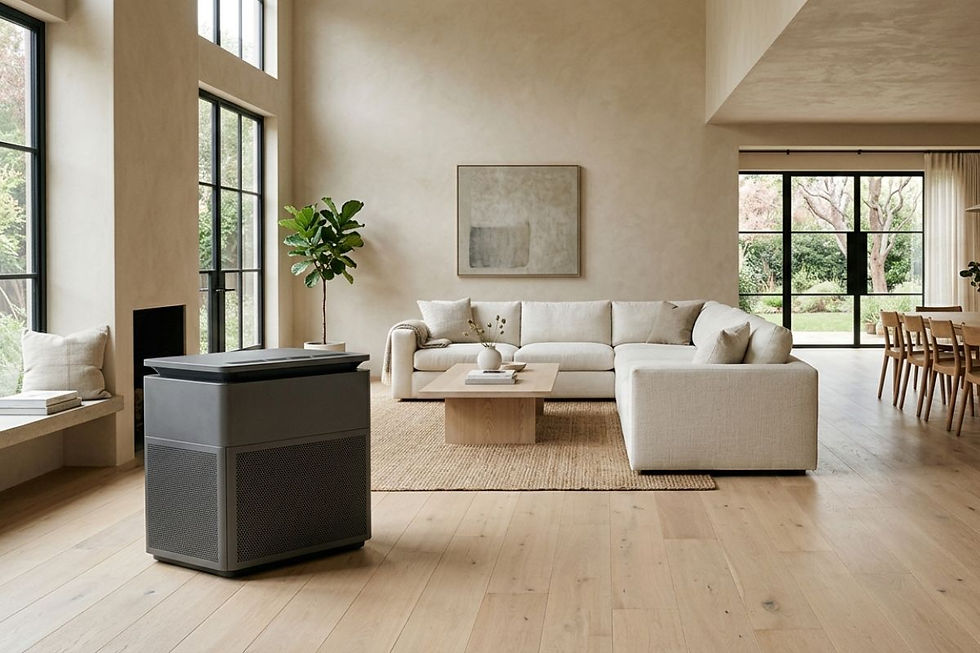
We evaluated 16 portable air purifiers sold for larger spaces, and nine made the final lineup. The clearest pattern was simple: manufacturer room-coverage claims are not directly comparable unless the air-change assumption is the same. A purifier advertised for thousands of square feet at one air change per hour may be a much smaller-room machine when you ask it to circulate filtered air nearly five times per hour.
That is why this guide starts with particulate airflow and normalized room fit, not the biggest square-foot number on the box. We use smoke CADR and a 4.8-equivalent-air-changes-per-hour benchmark at an 8-foot ceiling, then compare filtration, noise at useful speeds, filter cost, energy use, placement, warranty, and long-term ownership.
If you want broader purifier recommendations focused on filtration technology and ozone/ionization tradeoffs rather than room size, start with our Best Non-Toxic Air Purifiers guide.
Affiliate & Methodology Disclosure
This article contains Amazon affiliate links. As an Amazon Associate, Zenda Guide earns from qualifying purchases at no extra cost to you. Our recommendations are based on data analysis and public certifications (such as HEPA standards, CARB listings, and verified-purchase reviews). Zenda Lab scores are derived from data synthesis — we do not run physical product tests.
Quick Answer: Which Large-Room Air Purifier Should You Buy?
Best overall: Coway Airmega ProX. It gives the strongest balance of high standardized airflow, usable noise, filtration, and ownership support in the final lineup.
For the most airflow: Medify MA-112 V3.0. Its 594-CFM smoke CADR is the highest official figure among our finalists, but filter costs are substantial.
For quieter large-room use: Blueair Blue Pure 211i Max. It stands out for how much clean air it can deliver before noise becomes intrusive.
For smart value: Levoit Core 600S-P. It combines 391-CFM capacity, useful smart controls, and relatively manageable filter costs at a more mainstream price tier.
For premium particle filtration: IQAir Atem X. It offers strong particle-focused filtration, useful mid-speed airflow, flexible placement, and unusually explicit long-term support, but at a very high upfront price.
If odors or gaseous pollutants also matter: AirDoctor AD5500i Smart. Its dedicated carbon/VOC stage is more substantial than the light carbon support found in many particle-first purifiers, although gas performance is not expressed by particle CADR.
Quick Picks
Coway Airmega ProX — Best Overall for Large Rooms — Very large rooms and open plans; 568 CFM smoke CADR; best balance of capacity, noise, and ownership support.
Medify MA-112 V3.0 — Best High-Airflow Option — Very large spaces where raw clean-air delivery matters more than automation or low operating cost.
Blueair Blue Pure 211i Max — Best Quiet Large-Room Air Purifier — Large bedrooms and living spaces where the purifier needs to run for long stretches without dominating the room acoustically.
Levoit Core 600S-P — Best Smart Value — Mainstream smart-home buyers who want strong large-room performance without premium pricing.
IQAir Atem X — Best Premium Particle-Filtration Option — High-budget buyers prioritizing particle filtration, placement flexibility, and long-horizon manufacturer support
The Best Air Purifiers for Large Rooms at a Glance
Zenda Practical Coverage uses the same 4.8-eACH, 8-foot-ceiling benchmark across products so the figures are comparable.
Tap on any product name to jumo to the full review.
|
|
|
Blueair Blue Signature Large SP4i
|
|
|
|
|
Alen BreatheSmart 75i V2 Essential
|
How We Evaluated Large-Room Air Purifiers
For this category, airflow had to do more than earn a few extra points. It was the qualification layer. Products had to show enough credible particulate clean-air delivery to make sense for a genuinely large room before features, design, or brand familiarity could matter.
Our weighted Zenda PVS used: 35% large-room airflow and realistic coverage; 15% filtration architecture and pollutant fit; 15% noise at useful performance levels; 15% filter and operating economics; 10% durability, warranty, and support; 5% large-room usability and placement; and 5% feature value.
We normalized room fit around AHAM’s 4.8-ACH suggested-room-size framework. For broader consumer guidance, the EPA Guide to Air Cleaners in the Home also emphasizes matching CADR to room size and accounting for open plans and ceilings above eight feet.
Where a manufacturer published a much larger figure at one air change per hour, we kept that number in context rather than treating it as equivalent to high-turnover coverage. We also kept particulate CADR separate from odor and gas filtration: a strong smoke CADR does not tell you how much gas a carbon stage can adsorb.
Learn more about our Zenda Lab Protocol and Editorial Standards.
What Counts as a Large Room?
For this guide, we treat roughly 500 square feet with an 8-foot ceiling — or a room with a similar air volume — as the starting point for “large-room” shopping. That is an editorial working definition, not an industry-wide label. The more important question is how much clean air the purifier can deliver relative to the volume of the space.
A useful shortcut
At an 8-foot ceiling, a 4.8-eACH target requires roughly 320 CFM for 500 ft², 384 CFM for 600 ft², 480 CFM for 750 ft², and 640 CFM for 1,000 ft². The familiar “2/3 rule” is a rough consumer shortcut that lands in a similar range; higher ceilings require more capacity.
Shopping for a much smaller space? If you only need filtration close to a desk, bedside, or personal workspace, our Best Desktop Air Purifiers guide compares compact options designed for more localized use.
Why Advertised Room Coverage Can Be Misleading
The same purifier can honestly be described with several room-size numbers. A brand might show the area it can serve once per hour, twice per hour, or close to five times per hour. The square-foot figure gets larger as the assumed turnover gets slower.
That is why the Coway Airmega ProX can be advertised for more than 4,000 square feet at one air change per hour while Zenda’s normalized 4.8-eACH reference is about 888 square feet. Both numbers describe the same fan and filter system under different assumptions; they do not describe the same level of air circulation.
For large-room shopping, compare the turnover assumption first. Then ask whether the purifier is quiet enough, affordable enough to maintain, and easy enough to place that you will actually run it at useful speeds.
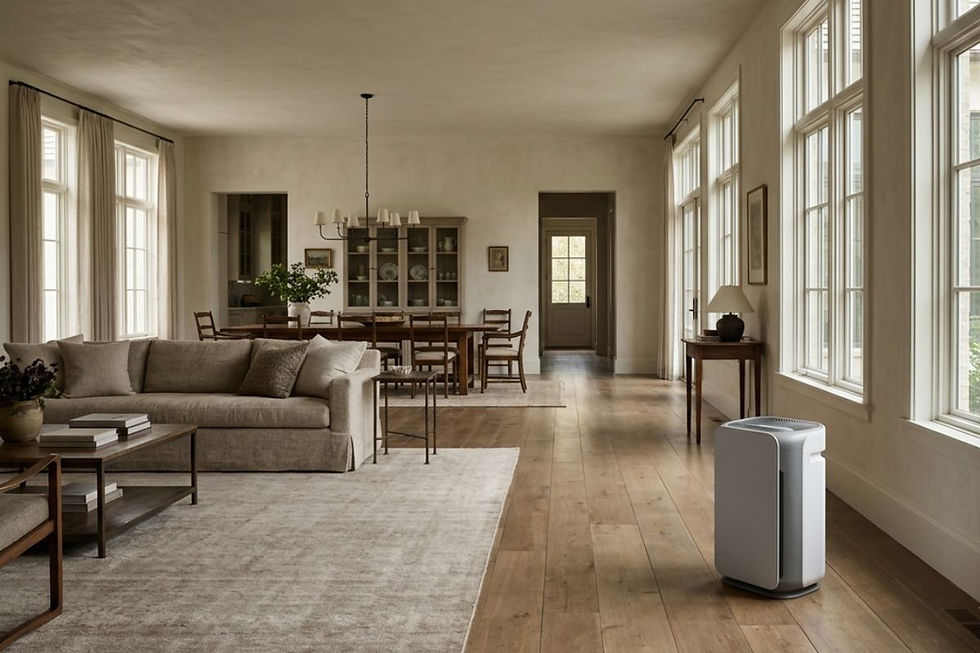
The 9 Best Air Purifiers for Large Rooms
The products below follow the Gate 2 editorial order. That order is not a simple PVS sort: we also considered how directly each purifier serves large-room intent, whether it adds a distinct buyer solution, and whether another model already covers the same role more convincingly.
1. Coway Airmega ProX
Best Overall for Large Rooms
Zenda PVS Score: 8.7 / 10
The Airmega ProX is our best overall large-room pick because it combines genuinely high standardized airflow with unusually credible noise performance for its capacity class. Its official 568-CFM smoke CADR translates to about 888 square feet on Zenda's 4.8-eACH comparison basis, while independent testing found that it retains strong cleaning performance without requiring the fan to stay at its loudest setting. That balance matters more for real large-room use than the biggest square-foot claim on a product page.
Quick Specs
Best For: Very large rooms and open plans
Smoke CADR: 568 CFM
Zenda Practical Coverage: ~888 ft² at 4.8 eACH, 8-ft ceiling
Manufacturer Coverage: 4,253 ft² at 1 ACH / 2,126 ft² at 2 ACH
Filtration: Dual washable prefilters + dual Max2 HEPA/carbon filters
Noise: 23-46 dB(A) official; 37.4-53.6 dBA independent
Filter Cost: ~$199/year
Energy Use: 65 W maximum
Warranty: 5 years motor/electronics; 1 year other functional parts
Main Tradeoff: Large, heavy, premium-priced; no exact-model app control verified
Why It Stands Out
The ProX gives this lineup a true upper-capacity anchor rather than an inflated-coverage marketing pick. Two-sided intake, dual Max2 filters, wheels, side handles, and particle sensing make the high airflow practical to live with. It also uses a conventional particle-plus-activated-carbon architecture, so the recommendation does not depend on a proprietary gas-removal or health claim.
Large-Room Performance
Coway publishes 568 CFM smoke CADR, which works out to about 8.5 equivalent air changes per hour in a 500-square-foot room, 5.7 in 750 square feet, and 4.3 in 1,000 square feet at an 8-foot ceiling. Coway also advertises 4,253 square feet at one air change per hour, but that figure is not comparable to Zenda’s high-turnover benchmark and should not be treated as the primary room recommendation.
Filtration, Noise & Ownership
Official noise is 23-46 dB(A), while independent testing measured roughly 37.4-53.6 dBA at three feet and found strong performance at lower fan speeds. The exact Max2 replacement set is about $199 with a stated one-year life, and official maximum power is 65 W. Warranty coverage is strongest on the components most central to airflow: five years for the motor and electronics, with one year on other internal or functional parts.
Best For: Very large rooms and open-plan spaces where high clean-air delivery needs to remain usable at moderate noise.
Not Best For: Tight floor plans, lower budgets, or buyers who specifically want verified app/Wi-Fi control.
Main Tradeoff: Excellent capacity comes with a 51-lb chassis, substantial floor space, roughly $199 in annual OEM filters, and no exact-model app compatibility verified in the evaluation.
Bottom Line
Choose the ProX when room size and clean-air delivery are the first constraints, but you still want a purifier that can operate at useful speeds without becoming an obvious noise penalty. It is overkill for modest rooms and not the cheapest purifier to own, yet no other finalist combines its capacity, noise balance, and ownership support as completely.
2. Medify MA-112 V3.0
Best High-Airflow Option for Very Large Rooms
Zenda PVS Score: 8.2 / 10
The MA-112 earns the second slot because it delivers the highest official smoke CADR in the approved lineup: 594 CFM. Medify also publishes unusually transparent room sizing at multiple air-change rates, including 928 square feet at 4.8 ACH, so its large-room case does not depend on a vague maximum-coverage headline. It is the better fit than a smart purifier when the priority is simply moving a lot of filtered air through a very large room.
Quick Specs
Best For: Maximum airflow with straightforward local controls
Smoke CADR: 594 CFM
Zenda Practical Coverage: ~928 ft² at 4.8 eACH, 8-ft ceiling
Manufacturer Coverage: 928 ft² at 4.8 ACH / 1,114 ft² at 4 ACH / 4,455 ft² at 1 ACH
Filtration: Prefilter + current Medify particle media + pelletized activated carbon
Noise: 35.8-56.5 dBA across speeds 1-4
Filter Cost: ~$334-$417/year at MSRP
Energy Use: 95 W rated
Warranty: Limited lifetime, conditional
Main Tradeoff: High recurring filter cost and simple controls
Why It Stands Out
This is a high-capacity purifier with straightforward local controls rather than a connected appliance. Four fan speeds, sleep mode, timer, child lock, wheels, and a substantial pelletized-carbon stage cover the essentials without Wi-Fi, app accounts, or automated sensing. That simplicity can be a benefit for buyers who want the machine to do one job well.
Large-Room Performance
At 594 CFM, the MA-112 provides roughly 8.9 eACH in 500 square feet, 5.9 in 750 square feet, and 4.5 in 1,000 square feet at an 8-foot ceiling. That gives it slightly more raw airflow headroom than the ProX, though the ProX ultimately scores higher because its noise and ownership economics are better balanced.
Filtration, Noise & Ownership
Manufacturer noise runs from 35.8 to 56.5 dBA across the four primary speeds. The filter set costs about $138.99, but Medify rates it for only around 3,000 hours, so annual filter cost can reach roughly $334-$417 at full MSRP. Rated power is 95 W. Medify’s limited lifetime warranty is a meaningful support advantage, but it is conditional on registration and warranty compliance rather than an unconditional lifetime replacement promise.
Best For: Large-room buyers who prioritize maximum airflow and straightforward local controls over automation.
Not Best For: Buyers focused on low running costs, low energy use, automatic particle sensing, or app-based control.
Main Tradeoff: The 594-CFM airflow is excellent, but the short filter interval can make ownership expensive, and the 95-W platform lacks sensors, Auto Mode, and app control.
Bottom Line
Choose the MA-112 when your room is genuinely large and you value clean-air capacity more than smart features. Its airflow is among the strongest we found, but the ongoing filter and energy burden means it is not a value winner simply because it moves more air.
3. Blueair Blue Pure 211i Max
Best Quiet Large-Room Air Purifier
Zenda PVS Score: 8.2 / 10
The Blue Pure 211i Max is the quieter-use standout because its recommendation is based on how much clean air it can deliver before noise becomes intrusive, not just on its maximum CADR. Blueair rates it at 435 CFM, while independent testing measured about 224 CFM of PM1 clean-air delivery at or below 45 dBA. That makes it especially compelling for large bedrooms, living rooms, and shared spaces where a purifier needs to run for long periods.
Quick Specs
Best For: Large living rooms and bedrooms where quieter useful airflow matters
Smoke CADR: 435 CFM
Zenda Practical Coverage: ~680 ft² at 4.8 eACH, 8-ft ceiling
Manufacturer Coverage: 674 ft² at 4.8 ACH / 1,618 ft² in 30 min / 3,235 ft² in 1 hr
Filtration: Fabric prefilter + Particle & Carbon filter + HEPASilent electrostatic assistance
Noise: 23-53 dB official; ~224 CFM PM1 CADR at ≤45 dBA independent
Filter Cost: ~$93/year at one-time pricing
Energy Use: 46 W
Warranty: 1 year; 3 years with registration
Main Tradeoff: Light carbon and non-disableable electrostatic assistance
Why It Stands Out
Blueair pairs strong large-room airflow with a compact 16.2-lb cylindrical chassis, PM1/PM2.5/PM10 monitoring, Auto and Night modes, app control, and low power use. Its filter economics are also unusually good for this capacity tier. The result is a purifier that is easier to keep running at useful settings rather than one that looks powerful only on a maximum-speed specification sheet.
Large-Room Performance
The 435-CFM smoke CADR corresponds to about 680 square feet at Zenda’s 4.8-eACH benchmark. Blueair itself publishes 674 square feet at 4.8 ACH, which closely matches the normalized calculation. Its much larger 3,235-square-foot one-hour figure is a lower-turnover expression and should stay secondary.
Filtration, Noise & Ownership
Official noise is 23-53 dB, while independent testing measured 33.9-58.7 dBA and about 224 CFM below 45 dBA. The standard replacement filter costs $69.99 and Blueair states up to nine months of life, equating to roughly $93 per year at one-time pricing. Power is only 46 W. Warranty coverage is one year by default and extends to three years with registration.
Best For: Large living rooms, open plans, and large bedrooms where strong particle airflow at quieter settings matters.
Not Best For: Buyers prioritizing substantial gas/odor adsorption or anyone specifically avoiding non-disableable electrostatic particle charging.
Main Tradeoff: Its HEPASilent system uses non-disableable electrostatic assistance and the standard carbon stage is relatively light; it also lacks the very-large-room headroom of the ProX or MA-112.
Bottom Line
Choose the 211i Max when you need a real large-room purifier but expect to live, work, or sleep near it. It gives up some raw capacity and gas-media depth versus the higher-end leaders, but its airflow-to-noise and ownership-cost balance is among the best in the final lineup.
4. Blueair Blue Signature Large SP4i
Best Design-Focused Large-Room Air Purifier
Zenda PVS Score: 8.4 / 10
The Blue Signature Large is the rare design-led purifier that also earns its place on performance. Its 455-CFM smoke CADR translates to about 711 square feet at Zenda’s high-turnover benchmark, yet the chassis weighs only 13.2 pounds and occupies a relatively compact 15.5-by-15.5-inch footprint. Independent testing also supports strong clean-air delivery at moderate noise, so its appearance is not compensating for weak purification.
Quick Specs
Best For: Visible living spaces where design and real large-room airflow both matter
Smoke CADR: 455 CFM
Zenda Practical Coverage: ~711 ft² at 4.8 eACH, 8-ft ceiling
Manufacturer Coverage: 705 ft² at 4.8 ACH / 3,385 ft² at 1 ACH
Filtration: Fabric prefilter + Particle & Carbon filter using HEPASilent
Noise: 23-55 dB official; ~37.2-58.5 dBA independent
Filter Cost: ~$100/year if replaced annually
Energy Use: 3.5-42 W
Warranty: 1 year; 3 years with registration
Main Tradeoff: Premium design price; electronically assisted filtration
Why It Stands Out
Its differentiator is how easily true large-room performance fits into a visible living space. The side outlet, optional furniture-style bases, app controls, particulate sensing, Auto/Night modes, and RealTrack filter monitoring make the Signature feel less like an industrial floor appliance. Low power draw and roughly annual filter replacement also keep the design premium from becoming a recurring-cost penalty.
Large-Room Performance
Blueair publishes 455 CFM smoke CADR and 705 square feet at 4.8 ACH, almost identical to Zenda’s calculated 711 square feet. The 3,385-square-foot headline corresponds to one air change per hour and should remain contextual rather than being treated as practical high-turnover coverage.
Filtration, Noise & Ownership
Official noise is 23-55 dB, and independent measurements fall roughly between 37 and 59 dBA depending on mode. Maximum power is just 42 W. The exact OEM replacement filter costs about $99.99 and Blueair states up to one year of life. The warranty begins at one year and extends to three years with registration, which is credible support but not category-leading long-term protection.
Best For: Design-conscious buyers who need true large-room airflow but want a compact, quiet, furniture-friendly purifier in a visible living space.
Not Best For: Buyers who need the most airflow possible, a large dedicated carbon bed, or purely mechanical particle filtration.
Main Tradeoff: You pay a premium for a newer design-led platform, while its HEPASilent system still uses electrostatic assistance and its 455-CFM airflow does not match the top-capacity models.
Bottom Line
Choose the Signature Large when you want a purifier that can genuinely serve a large room without visually taking over it. You can buy more airflow or more specialized filtration elsewhere, but few finalists combine strong capacity, quiet-use evidence, low power, and a furniture-friendly footprint as convincingly.
5. AirDoctor AD5500i Smart
Best When Odor Filtration Also Matters
Zenda PVS Score: 7.9 / 10
The AD5500i earns a distinct role because it does more than pair a powerful fan with a thin carbon sheet. Its dedicated Premium Carbon/VOC filters use activated carbon plus potassium permanganate, separate from the UltraHEPA particle filters, while the purifier still delivers 556 CFM of official smoke CADR. That makes it one of the more relevant finalists when odors or gaseous pollutants are part of the buying decision as well as airborne particles.
Quick Specs
Best For: Large spaces needing strong particle airflow plus a dedicated odor/gas media stage
Smoke CADR: 556 CFM official; 534 CFM independent exact-model test
Zenda Practical Coverage: ~869 ft² at 4.8 eACH using official CADR
Manufacturer Coverage: 1,043 ft² at 4 air changes/hour
Filtration: Permanent prefilters + Premium Carbon/VOC + UltraHEPA; optional ionizer can be disabled
Noise: 44.4-66.9 dB independent
Filter Cost: ~$355/year current combo pack
Energy Use: Controlled — exact smart-model wattage needs final recheck
Warranty: 1 year
Main Tradeoff: Expensive filters, loud top speed, short warranty
Why It Stands Out
AirDoctor separates its particle and gas media, so the filtration architecture is easier to understand and maintain than a single bonded cartridge. The smart model also adds Wi-Fi, app control, AQI/PM2.5 sensing, Auto/Boost behavior, schedules, filter alerts, and six fan speeds. The optional ionizer can be switched off, allowing buyers to use the primary filtration stages without it.
Large-Room Performance
At 556 CFM, the AD5500i normalizes to about 869 square feet at 4.8 eACH. AirDoctor publishes 1,043 square feet at four air changes per hour, which is a useful and transparent assumption rather than a one-ACH maximum. Independent testing on the exact smart model reported 534 CFM, close enough to confirm the same very-high-capacity class while remaining a separate source result.
Filtration, Noise & Ownership
Noise is the biggest performance caveat: independent testing measured 44.4 dB at minimum and 66.9 dB at maximum. The current one-year filter bundle is around $355, among the highest recurring costs in the lineup. The exact smart-model rated wattage was not cleanly established in the approved evaluation and remains controlled until the final pre-publish recheck. Warranty coverage is only one year.
Best For: Large spaces where strong particle airflow needs to be paired with a more substantial dedicated odor/gas filtration stage and smart controls.
Not Best For: Budget-conscious buyers, low-maintenance households, or anyone prioritizing quiet maximum-speed operation and long warranty coverage.
Main Tradeoff: Its dedicated carbon/VOC media is unusually substantial, but annual filters are around $355, independent maximum noise reached 66.9 dB, and the warranty is only one year.
Bottom Line
Choose the AD5500i when you want very high particle airflow and a dedicated odor/gas-media stage in the same smart purifier. It is not the cheapest or quietest way to clean a large room, and the gas advantage is architectural rather than backed by a standardized gas CADR, but the filtration design is more purposeful than most particle-first competitors.
6. Levoit EverestAir-P
Best for Flexible Placement
Zenda PVS Score: 7.8 / 10
The EverestAir-P is the best choice when room layout is almost as important as room size. Its 354-CFM CADR is enough for roughly 553 square feet on Zenda’s benchmark, while a slim 8.5-inch depth, directional caster wheels, and an adjustable 45- to 90-degree outlet make it easier to position around furniture, walls, and traffic paths than many boxier high-capacity purifiers.
Quick Specs
Best For: Large rooms with placement constraints, furniture, or preferred airflow direction
Smoke CADR: 354 CFM
Zenda Practical Coverage: ~553 ft² at 4.8 eACH, 8-ft ceiling
Manufacturer Coverage: 549 ft² at 4.8 ACH / 2,635 ft² at 1 ACH
Filtration: Washable prefilter + particle filter + honeycomb/pelleted activated carbon
Noise: 24-56 dB official; ~39.1-57.8 dBA independent
Filter Cost: ~$80-$100/year
Energy Use: 70 W rated
Warranty: 2 years
Main Tradeoff: Excellent placement and controls, but moderate airflow headroom
Why It Stands Out
Levoit combines physical flexibility with one of the stronger smart-control packages in the lineup: PM1, PM2.5, and PM10 sensing, Auto and Sleep modes, VeSync app control, scheduling, clean-air percentage, and Alexa/Google Assistant support. The filtration stack also includes a washable prefilter and pelleted activated carbon rather than relying on features alone.
Large-Room Performance
The official 354-CFM CADR aligns with Levoit’s 549-square-foot rating at 4.8 ACH and Zenda’s calculated 553-square-foot practical coverage. Independent testing measured about 375 CFM at maximum and about 205 CFM below 45 dBA. That is respectable usable airflow, but the EverestAir is not the right single-unit choice when a 750- or 1,000-square-foot space requires high turnover.
Filtration, Noise & Ownership
Official noise is 24-56 dB, with independent multi-speed measurements around 39.1-57.8 dBA. The exact OEM replacement filter costs $99.99 and is rated for roughly 12-15 months, producing an annualized cost near $80-$100. Rated power is 70 W, and warranty coverage is two years. Ownership support is solid, though repairability remains typical of a modern smart appliance.
Best For: Buyers who need true large-room purification with a slim footprint, wheels, directional airflow, and advanced smart controls.
Not Best For: Very large 750-1,000-square-foot rooms that need high air turnover from a single purifier, or buyers who only care about maximum airflow per dollar.
Main Tradeoff: Its slim directional design is unusually practical, but 354 CFM provides much less room-size headroom than the leading large-space models and peak power is 70 W.
Bottom Line
Choose the EverestAir when a large room has awkward furniture, wall constraints, or a preferred airflow direction and you still want strong smart controls. It does not compete with the ProX or MA-112 on raw capacity, but its physical design can make the airflow it has easier to use effectively.
7. IQAir Atem X
Best Premium Particle-Filtration Option
Zenda PVS Score: 7.9 / 10
The Atem X is the premium particle-filtration option for buyers willing to pay for a more engineered ownership and support system rather than simply the highest CADR. Its official 422-CFM smoke CADR supports about 659 square feet at Zenda’s benchmark, and independent testing measured roughly 229 CFM of PM1 clean-air delivery while staying below 45 dBA. Wall/corner placement, an adjustable outlet, and eight speeds add flexibility that is unusual in this price class.
Quick Specs
Best For: Premium particle-focused filtration and long-horizon support
Smoke CADR: 422 CFM
Zenda Practical Coverage: ~659 ft² at 4.8 eACH, 8-ft ceiling
Manufacturer Coverage: Up to ~1,650 ft² at lower turnover
Filtration: Washable impactor pre-separators + HyperHEPA HF particle filters
Carbon: No dedicated activated-carbon stage in evaluated configuration
Noise: ~35.6-62.3 dBA independent; ~229 CFM under 45 dBA
Filter Cost: ~$199.99/set; practical interval uncertain
Energy Use: Up to 86 W
Warranty: 1 year base; up to 10 years conditional + separate 25-year support commitment
Main Tradeoff: Very high purchase price; no dedicated carbon stage
Why It Stands Out
IQAir’s differentiators are the particle-focused HyperHEPA system, detachable mobile base, AirVisual controls, and its long-term manufacturer support framework. The company offers a one-year base warranty with a conditional extension to ten years and separately publishes a 25-year maintenance and repairability commitment. Those support promises are more explicit than most competitors, even though they should not be confused with proof that the product itself will operate fault-free for decades.
Large-Room Performance
At 422 CFM, the Atem X provides about 6.3 eACH in 500 square feet and 4.2 in 750 square feet. Independent testing measured about 429 CFM at top speed, closely supporting the official capacity class, plus about 229 CFM below 45 dBA. Its broader roughly 1,650-square-foot positioning uses lower turnover and should not replace the normalized large-room figure.
Filtration, Noise & Ownership
The major economic barrier is the roughly $1,400 purchase price recorded during evaluation. Replacement HyperHEPA sets are about $199.99, but available guidance varies enough that Zenda should present practical filter life as unresolved rather than selecting the most favorable multi-year estimate. Power ranges from very low single-digit watts to about 86 W at maximum. The exact evaluated configuration contains no dedicated activated carbon, so it should not be positioned as an odor/VOC specialist.
Best For: High-budget buyers who prioritize particle filtration, quiet mid-speed operation, wall/corner placement, and unusually explicit long-term manufacturer support.
Not Best For: Odor/VOC-focused households, value shoppers, or anyone who wants a straightforward low-cost replacement-filter schedule.
Main Tradeoff: The evaluated Atem X has no dedicated activated-carbon stage, carries a very high acquisition cost, and its practical filter-replacement interval remains uncertain across available sources.
Bottom Line
Choose the Atem X when premium particle filtration, quiet mid-speed airflow, placement flexibility, and long-term manufacturer support matter more than price. It is not the most complete all-pollutant solution in this lineup, but it offers a distinctive premium case for particles and ownership support.
8. Levoit Core 600S-P
Best Smart Value
Zenda PVS Score: 7.3 / 10
The Core 600S-P is the smart-value pick because it combines a verified 391-CFM CADR, explicit 4.8-ACH sizing, and a mature app ecosystem at a more mainstream price than the premium finalists. It is compact and light for its airflow class, with a PM2.5 display, Auto and Sleep modes, schedules, history, filter tracking, and voice-assistant support.
Quick Specs
Best For: Smart controls + strong large-room airflow at a mainstream price tier
Smoke CADR: 391 CFM
Zenda Practical Coverage: ~611 ft² at 4.8 eACH, 8-ft ceiling
Manufacturer Coverage: 606 ft² at 4.8 ACH / 2,909 ft² at 1 ACH
Filtration: Prefilter + particle filter + pelletized activated carbon with ARC Formula
Noise: 26-55 dB official; ~156 CFM PM1 CADR under 45 dBA independent
Filter Cost: ~$60-$120/year
Energy Use: 49 W
Warranty: 2 years
Main Tradeoff: High-speed noise limits comfortable continuous output
Why It Stands Out
Levoit gives buyers a clear, familiar path into large-room purification without stripping away the decision features that make a purifier easier to run every day. The filter includes pelletized activated carbon, official power is just 49 W, and the exact replacement cartridge is inexpensive relative to the airflow. Its weakness appears when maximum output and acceptable noise have to happen at the same time.
Large-Room Performance
The official 391-CFM CADR corresponds to about 611 square feet on Zenda’s benchmark and closely matches Levoit’s own 606-square-foot rating at 4.8 ACH. Independent testing measured about 375 CFM at top speed but only about 156 CFM below 45 dBA. That makes the Core 600S a strong general large-room value, not a substitute for the higher-capacity models in genuinely huge spaces.
Filtration, Noise & Ownership
Official noise is 26-55 dB, while independent testing measured 37.9-62.3 dBA. The OEM filter costs $59.99 and is typically rated for six to 12 months, so annual filter expense is roughly $60-$120. Power is 49 W, and the warranty is two years. The evaluation also flagged OEM stock variability, which should be refreshed as a commercial availability control rather than treated as a permanent weakness.
Best For: Readers prioritizing smart controls, compact placement, and strong large-room particle airflow at a more mainstream price.
Not Best For: Very large or high-volume rooms that need 750-1,000-square-foot high-turnover performance, or buyers who need strong quiet-speed airflow.
Main Tradeoff: It delivers a lot of maximum-speed airflow for the price, but independent testing found the top setting much louder than the official figure and only about 156 CFM below 45 dBA.
Bottom Line
Choose the Core 600S-P when you want a capable large-room purifier with strong smart features and manageable ownership costs without entering premium pricing. If your priority is very-high-capacity quiet airflow, spend more on one of the leaders; if your priority is smart value, this is the more balanced buy.
9. Alen BreatheSmart 75i V2 Essential
Best for Lower Running Costs
Zenda PVS Score: 7.3 / 10
The 75i V2 closes the lineup with a different kind of value: lower ongoing cost rather than a low purchase price. Its 347-CFM CADR is enough for about 542 square feet at Zenda’s 4.8-eACH benchmark, while the Essential/Pure filter is rated for 12-15 months and costs about $99. Add low power consumption, a mature filter ecosystem, and Alen’s conditional Forever Guarantee, and the ownership case is stronger than the raw airflow ranking suggests.
Quick Specs
Best For: ~500-ft² high-turnover rooms where long-term running costs matter
Smoke CADR: 347 CFM
Zenda Practical Coverage: ~542 ft² at 4.8 eACH, 8-ft ceiling
Manufacturer Coverage: Up to 2,800 ft² in 60 minutes at highest setting
Filtration: Essential/Pure H13 particle filter + prefilter; optional ionizer
Carbon: None in exact Essential/Pure configuration
Noise: 25-49 dBA official; ~164 CFM PM1 CADR at 44.7 dBA independent
Filter Cost: ~$79-$99/year
Energy Use: 1.36-55 W official
Warranty: Conditional Forever Guarantee
Main Tradeoff: Modest airflow and no carbon in exact configuration
Why It Stands Out
This is a premium smart purifier for buyers who expect to keep a product for years and want predictable consumables. It includes laser particle sensing, Auto Mode, app controls, schedules, a five-color AQI ring, and wheels, while core functions remain available on the machine itself. The exact Amazon configuration is important: the Essential/Pure filter is particle-focused and does not include the substantial carbon found in Alen’s optional Fresh or Odor variants.
Large-Room Performance
At 347 CFM, the 75i V2 clears the main large-room intake gate but has much less headroom than the 400-600-CFM leaders. Zenda Practical Coverage is about 542 square feet at 4.8 eACH. The 2,800-square-foot manufacturer headline is a one-hour/low-turnover expression and should not be used as the primary sizing recommendation.
Filtration, Noise & Ownership
Official noise is 25-49 dBA; independent testing measured 36.5-57.5 dBA and about 164 CFM at 44.7 dBA. The Essential/Pure filter costs around $99 and is rated for 12-15 months, giving an annualized filter cost of roughly $79-$99. Power ranges from 1.36 to 55 W officially. Alen’s Forever Guarantee is a notable support benefit, but it is conditional on registration and continuing genuine-filter requirements.
Best For: Buyers who want a premium smart purifier for roughly 500-square-foot high-turnover use with low power, long filter life, and unusually strong long-term support.
Not Best For: Very large rooms that need the strongest airflow headroom or households buying primarily for odors/VOCs with the exact Amazon configuration.
Main Tradeoff: The 347-CFM airflow sits near the bottom of the main large-room lane, and the exact Essential/Pure Amazon model has no activated-carbon stage despite the premium purchase price.
Bottom Line
Choose the 75i V2 when the room is around the 500-square-foot high-turnover class and you care about lower recurring costs, smart controls, and long-term filter support. It is not the right finalist for maximum airflow or odor-focused filtration in this exact configuration, but its ownership economics give it a legitimate role that the higher-CADR models do not duplicate.
How Much Airflow Do You Need for a Large Room?
Start with the room’s floor area, then adjust for ceiling height. At an 8-foot ceiling, Zenda’s 4.8-eACH benchmark needs roughly 0.64 CFM of smoke CADR per square foot. That means about 320 CFM for 500 square feet, 480 CFM for 750 square feet, and 640 CFM for 1,000 square feet.
Room size (8-ft ceiling) | Approx. CADR for 4.8 eACH | What that means in this guide |
500 ft² | ~320 CFM | All nine finalists qualify; lower-CADR picks have less headroom. |
600 ft² | ~384 CFM | Look toward Core 600S, Atem X, Blueair, AirDoctor, Medify, or ProX. |
750 ft² | ~480 CFM | The high-capacity leaders make more sense if you want ~4.8 eACH from one unit. |
1,000 ft² | ~640 CFM | None of the finalists reaches 4.8 eACH at this size from one unit; consider lower turnover or multiple purifiers. |
What Changes With High Ceilings?

Ceiling height changes room volume even when floor area stays the same. A 500-square-foot room with a 12-foot ceiling contains about the same air volume as a 750-square-foot room with an 8-foot ceiling. A simple way to adjust is to multiply the floor area by ceiling height divided by eight, then size the purifier for that equivalent area.
Example
500 ft² × (12 ft ÷ 8 ft) = 750 ft² equivalent room volume. For a high-turnover target, shop closer to the airflow you would choose for a 750-ft² standard-height room.
What About Open Floor Plans?
For an open plan, size the connected area the purifier is realistically expected to serve, not just the corner where the machine sits. A large living room that opens directly into a kitchen and dining area may behave more like one large air volume than three isolated rooms.
That does not mean one portable purifier becomes a whole-house system. Walls, hallways, closed doors, furniture, and distance all affect how air moves. If the space is long, L-shaped, divided by partial walls, or difficult to reach from one central position, two units may distribute clean air more evenly than one larger purifier.
One Large Air Purifier or Two Smaller Ones?

One large purifier is usually simpler when the room is genuinely open, there is a good central placement, and the unit can reach your target airflow without becoming too loud. Two smaller purifiers can make more sense when the room is very large, irregularly shaped, divided into zones, or when running two units at lower speeds produces a more comfortable noise profile.
Do not compare the choice by square-foot marketing alone. Compare total clean-air delivery, where each intake and outlet can actually sit, filter costs for one versus two machines, energy use, and whether the layout lets clean air reach the areas where people spend time.
How Noise Changes the Large-Room Decision
A purifier only helps at the speed you are willing to run. Large-room models often post their best CADR at maximum fan speed, but maximum speed may also be the setting you avoid during conversations, television, work, or sleep.
That is why independent lower-noise airflow evidence influenced our rankings. The Blue Pure 211i Max, for example, did not have the highest maximum CADR, but it delivered unusually strong clean-air output before crossing roughly 45 dBA in independent testing. The Core 600S-P had strong maximum airflow for the price but lost more usable output when noise was constrained.
Particle Filtration vs. Odors and VOCs
Particle filtration and gas filtration are different jobs. Smoke CADR tells us about clean-air delivery for particles; it does not quantify how effectively a purifier removes gases, odors, or VOCs. Carbon performance depends on the type and amount of sorbent media, contact time, pollutant concentration, and other conditions.
If you are deciding whether you need particle filtration, activated carbon, or both, read our HEPA vs Carbon Air Filters guide. For new-material or chemical-like odors, our VOCs in Homes guide explains why source reduction and ventilation still matter.
Filter Replacement and Long-Term Cost
Large-room purifiers move more air through larger filters, so recurring cost can be as important as the purchase price. In this lineup, annualized OEM filter estimates range from roughly $79-$100 for some long-life configurations to more than $300 for high-capacity systems with short filter intervals or multiple dedicated filter stages.
Before buying, check the exact replacement-filter SKU for the exact model, not just the brand. Also treat manufacturer replacement intervals as estimates: dust load, smoke, pets, fan speed, and local conditions can shorten real filter life.
Where to Place an Air Purifier in a Large Room
Give the intake and outlet enough open space to move air. Avoid blocking the purifier with sofas, curtains, shelving, or other furniture, and follow the manufacturer’s exact clearance guidance because intake and outlet designs vary.
In a large open room, place the unit where its cleaned-air path can reach the occupied space rather than hiding it in an unused corner. If the purifier has directional airflow, wheels, or side discharge, use those features to work with the room layout. In a divided space, it may be more effective to use multiple units than to force one purifier to serve around walls and doorways.
When an Air Purifier Is Not the Whole Solution
A portable purifier is a room-level filtration tool. It does not replace ventilation, source control, moisture management, or a central HVAC strategy. If stale air is the main problem, ventilation may matter more. If the room is damp or musty, moisture control comes first. If the concern is a strong chemical source, reducing or removing that source can matter more than adding a larger purifier.
For the bigger picture, use our Indoor Air Quality Guide. If mold or moisture is the real problem, move to Best Air Purifiers for Mold and our Air Purifier vs Dehumidifier comparison rather than treating a large-room purifier as the entire solution.
How to Choose the Right Large-Room Air Purifier
Size the air volume, not just the floor area. Measure the connected space and adjust upward for ceilings above eight feet.
Compare smoke CADR on one common basis. A large marketing coverage number is not enough unless you know the assumed air changes per hour.
Decide whether particles or odors are the bigger problem. Particle CADR and carbon/gas filtration are separate performance questions.
Check useful-speed noise, not only the minimum dB claim. A quiet sleep mode tells you little about how loud the purifier becomes when it is actually moving enough air for a large room.
Price the filters before you buy the machine. A lower purchase price can become expensive if filters are frequent, proprietary, or difficult to source.
Match the chassis to the room. Weight, wheels, footprint, outlet direction, and intake clearance matter more as purifiers get larger.
Treat smart features as support, not the core decision. Sensors and apps can make consistent use easier, but they cannot compensate for insufficient clean-air delivery.
Final Recommendations
If you want one place to start, choose the Coway Airmega ProX. It is the strongest all-around fit for genuinely large rooms because it combines 568-CFM smoke CADR with better noise balance and ownership support than the other top-capacity finalists.
Choose the Medify MA-112 V3.0 when raw airflow is your priority and you are comfortable with higher filter and energy costs. Choose the Blueair Blue Pure 211i Max when quieter continuous use matters more than absolute maximum capacity. Choose the Levoit Core 600S-P when you want smart features and strong room-wide airflow at a more mainstream price. And choose the AirDoctor AD5500i Smart when dedicated odor/gas media is part of the brief as well as high particle airflow.
The bigger takeaway is not that one purifier wins every room. It is that large-room shopping gets easier once you stop treating every square-foot claim as equivalent. Size the room, normalize the airflow, then choose the noise, filtration, ownership cost, and placement tradeoffs you can actually live with.
Frequently Asked Questions
What CADR do I need for a large room?
For an 8-foot ceiling, Zenda’s 4.8-eACH comparison works out to roughly 0.64 CFM of smoke CADR per square foot. That is about 320 CFM for 500 ft², 480 CFM for 750 ft², and 640 CFM for 1,000 ft². Higher ceilings or unusually high particle loads may justify more capacity.
What is the 2/3 rule for air purifiers?
The 2/3 rule is a rough sizing shortcut: choose a tobacco-smoke CADR of at least about two-thirds of the room’s floor area in square feet. It is close to AHAM’s high-turnover room-size relationship for an 8-foot ceiling. Treat it as a starting point, not a substitute for checking ceiling height, layout, noise, and the purifier’s actual performance data.
Does ceiling height matter when sizing an air purifier?
Yes. A higher ceiling means more air volume even when the floor area is unchanged. EPA guidance specifically recommends considering a purifier sized for a larger area when ceilings are above eight feet. A 500-ft² room with a 12-ft ceiling has roughly the same volume as a 750-ft² room with an 8-ft ceiling.
Is it better to use one large air purifier or two smaller ones?
It depends on layout and noise. One high-capacity purifier is simpler in a truly open room with a good central placement. Two smaller units can distribute clean air more evenly in long, L-shaped, divided, or extremely large spaces, and may allow quieter operation at lower fan speeds.
Can one air purifier clean an open floor plan?
It can help when the purifier has enough clean-air delivery for the connected area and the airflow path is reasonably open. Size the whole space you expect the purifier to serve, not just the corner where it sits. Walls, hallways, closed doors, and furniture can make multiple units more practical.
Should an air purifier be on the floor or higher up?
Follow the manufacturer’s placement guidance for the exact model. Many large-room purifiers are designed as floor units. More important than height is keeping the intake and outlet unobstructed and placing the purifier where cleaned air can reach the occupied part of the room.
Do air purifiers remove odors and VOCs?
Particle filters and CADR do not measure gas removal. Activated carbon or other sorbent media can help with some gases and odors, but performance depends on the amount and type of media and the pollutant involved. Source reduction and ventilation may still be important, especially for VOCs.
Can a large-room air purifier replace ventilation or a dehumidifier?
No. A portable purifier filters air in a room; it does not replace fresh-air ventilation or remove moisture. If dampness or mold is the main concern, address the moisture source and use filtration as a supporting tool rather than the whole solution.
A calmer way to choose what comes into your home
Join the Zenda Guide newsletter for evidence-based product guides, material insights, and thoughtful home upgrades — no fear-based claims, no clutter.
Keep Exploring
Indoor Air Quality Guide — Start here for the broader ventilation, filtration, humidity, and source-control framework.
Best Non-Toxic Air Purifiers — Compare broader purifier options when room size is not the main constraint.
Best Desktop Air Purifiers —Compare compact options designed for more localized use.
Best Air Purifiers for Mold — Use this when mold, musty air, or moisture is the real decision.
HEPA vs Carbon Air Filters — Understand the difference between particle filtration and odor/gas support.
VOCs in Homes — Learn why source reduction and ventilation still matter for gaseous pollutants.
Clean Air & Healthy Home — Browse the full clean-air and home environment cluster.
About our editorial process
Zenda Guide reviews are produced by our Editorial Board using a documented methodology focused on durability, materials, and long-term value. Learn more about our Editorial Standards and Zenda Lab Protocol


Comments