Best Non-Toxic Cookware Sets for 2026

Updated: 1 day ago
Reviewed by Our Editors at Zenda Guide
Our content follows our Editorial Standards and is evaluated using the Zenda Lab Protocol.

If you search for non-toxic cookware, you will quickly find stainless steel, ceramic-coated, cast iron, titanium, and hybrid pans all described as “safe” in very different ways. The problem is that non-toxic cookware is not one standardized material category. For this guide, we focus on what we can actually verify: the food-contact surface, whether the cookware relies on a coating, what brands disclose about PFAS and PTFE where relevant, how the surface ages, how the set cooks, and whether you are paying for useful cookware rather than filler pieces.
Our 2026 re-evaluation found that the strongest complete sets split into distinct material pathways rather than one universal winner. All-Clad D3 is our Best Overall for an uncoated stainless route; GreenPan Valencia Pro is the strongest ceramic-coated easy-release option; and Cuisinart MultiClad Pro delivers the best stainless value. The rest of the lineup covers coating-free textured titanium, titanium-bonded stainless, enameled cast iron, and a current-generation hybrid system.
The goal is not to tell you that one material is universally “safest.” It is to make the tradeoffs visible enough that you can choose the surface, care routine, cooking behavior, and price level that actually fit your kitchen.
Affiliate disclosure: This article may contain affiliate links. If you buy through them, Zenda Guide may earn a commission at no extra cost to you. Affiliate relationships do not influence our scores, product order or recommendations. As an Amazon associate we earn from qualifying purchases.
Quick Answer: Which Non-Toxic Cookware Set Should You Choose?
Choose All-Clad D3 if you want the most balanced uncoated set and are comfortable cooking on stainless. Choose GreenPan Valencia Pro if easy release and cleanup matter more than maximizing surface recoverability. Choose Cuisinart MultiClad Pro if you want fully clad stainless at a lower price. Our Place Titanium Pro is the most interesting coating-free easy-release alternative, Hestan NanoBond is the splurge, Le Creuset is the slow-cooking specialist, and HexClad TerraBond is the hybrid option for browning plus easier cleanup.
Quick Comparison: The 7 Best Non-Toxic Cookware Sets
Tap on any product name to jump to the full review
|
GreenPan Valencia Pro 11-Piece
|
Cuisinart MultiClad Pro 12-Piece
|
Our Place Titanium Pro 10-Piece
|
|
|
|
What “Non-Toxic Cookware” Means in This Guide
We use non-toxic cookware as a consumer search term, not as a certification. A product can be marketed as “non-toxic” while telling you very little about its actual food-contact surface or how that surface changes with use. That is why our evaluation starts with the material system rather than the marketing label.
For every set, we look first at what actually touches food. Is the cooking surface uncoated stainless steel, ceramic nonstick, enamel, a textured titanium surface, a titanium-bonded metal treatment, or a hybrid of exposed metal and coating? If a coating is present, we check the brand’s current PFAS/PTFE disclosures and whether the exact commercial version matches those claims. A “PFOA-free” claim on its own is not treated as equivalent to broader PFAS disclosure, because PFOA is only one member of the larger PFAS family.
We also separate material disclosure from durability. A clearly disclosed coating can still be a poor long-term value if its release performance degrades quickly. Likewise, an uncoated metal surface can be very durable but still demand more technique or cleanup. Neither pathway wins automatically.
If you want the deeper chemistry and material-science layer, see our Cookware Materials Guide. This roundup stays focused on the buying decision: how the material system affects cooking, care, durability, set usefulness, and value.
How We Evaluated These Cookware Sets
This guide uses the 2026 Zenda Lab Protocol for Non-Toxic Cookware Sets, a category-specific research framework built for this roundup. Zenda Guide does not conduct independent laboratory or physical performance testing. Instead, we synthesize current manufacturer specifications, manuals, material and coating disclosures, warranty/support terms, credible independent specialist testing, retailer identity data, and recurring owner patterns.
Before any product can be scored, we lock the exact U.S. product identity: model or configuration, piece count, ASIN or retailer SKU, current material generation, and food-contact surface. That identity control matters because cookware formulations can change while product names stay similar.
The final Product Value Score (PVS) uses six weighted dimensions: Food-Contact Materials & Coating Transparency (25%), Durability & Construction (20%), Cooking Performance & Usability (20%), Set Composition & Practicality (15%), Verified Ownership Experience & Support (10%), and Long-Term Value (10%). We also assign an evidence-confidence level and apply Holds or score caps when the product identity or material evidence is not strong enough.
PVS is decision support, not automatic ranking. A higher-scoring product can still rank lower if it is much more expensive, overlaps another recommendation, or serves a narrower buyer. That is why Hestan NanoBond can score 9.2 while All-Clad D3 remains our Best Overall, and why Le Creuset earns a place despite several stainless sets scoring higher: its material pathway solves a different problem.

Best Non-Toxic Cookware Sets for 2026
1. All-Clad D3 10-Piece Stainless Steel Cookware Set
Best Overall — Uncoated Stainless Steel
Zenda Lab PVS: 9.1 / 10
All-Clad D3 earns our Best Overall spot because it gives the widest range of cooks a strong balance of uncoated stainless-steel construction, useful set composition, cooking versatility, mature ownership evidence, and long-term durability potential. It is not the highest raw PVS in our lineup, but it is the most complete expression of what this guide is trying to help readers find.
The D3 construction sandwiches an aluminum core between stainless-steel layers, giving the pans faster and more even heat response than single-layer stainless while keeping an uncoated stainless cooking surface. The current 10-piece set covers the major everyday jobs without inflating the count with utensils or accessories.
Quick Specs
Food-contact surface: Uncoated stainless steel
Construction: Fully bonded tri-ply with aluminum core
Coated or uncoated: Uncoated
Useful cookware: 6 vessels + 4 lids
Induction: Yes
Oven / broiler: Up to 600°F
Cleaning: Handwash
Best For: Durable all-around stainless cookware
Main Tradeoff: Premium price and a stainless-steel learning curve
D3's biggest strength is that it does not need a nonstick coating to deliver broad everyday performance. Stainless rewards correct preheating and enough cooking fat, and it can move from simmering and sautéing to browning, deglazing, braising, and oven finishing without a coating-specific heat ceiling. The tradeoff is technique: delicate foods can stick if the pan is too cool, too hot, or under-oiled, and cleanup may require more effort than ceramic-coated cookware.
The durability case is also strong without needing 'buy it for life' language. Its bonded construction, uncoated food-contact surface, mature ownership record, and limited lifetime defect warranty support strong long-term ownership potential. That makes D3 especially compelling for readers who would rather learn stainless technique than manage the gradual decline of an easy-release coating.
Best For
Cooks who want an uncoated, versatile set and are comfortable learning how stainless behaves. It particularly suits people who brown, sear, sauté, simmer, and move cookware between stovetop and oven.
Not Best For
Choose GreenPan instead if effortless release for eggs, pancakes, and delicate foods matters more than long-term surface recoverability. D3 may also be less appealing if you strongly dislike stainless cleanup or All-Clad’s traditional long-handle shape.
Bottom Line
All-Clad D3 is our Best Overall because it combines material simplicity, mature evidence, useful pieces, and broad cooking capability with fewer category-specific compromises than the alternatives.
2. GreenPan Valencia Pro 11-Piece Cookware Set
Best Ceramic-Coated — Easy Release
Zenda Lab PVS: 8.8 / 10
If your priority is easy food release and cleanup rather than an uncoated cooking surface, GreenPan Valencia Pro is the strongest ceramic-coated set in our evaluation. It combines a hard-anodized aluminum body with GreenPan's ceramic nonstick, and the current manufacturer language describes the coating as made without intentionally added PFAS.
The 11-piece configuration is also unusually practical for ceramic cookware: three fry pans, two covered saucepans, a covered sauté pan, and a covered stockpot. That gives it considerably more real cooking breadth than some lifestyle-oriented sets with similar advertised piece counts.
Quick Specs
Food-contact surface: Thermolon ceramic nonstick
Body: Hard-anodized aluminum
Coated or uncoated: Ceramic-coated
PFAS disclosure: Made without intentionally added PFAS
Useful cookware: 7 vessels + 4 lids
Induction: Yes
Oven safe: Cookware up to 600°F; lids up to 425°F
Best For: Ceramic easy-release performance
Main Tradeoff: Release performance depends on maintaining the coating
Valencia Pro's advantage over stainless is immediate usability. Eggs, pancakes, and other delicate foods are easier to release with less technique, and cleanup is usually simpler. The ownership tradeoff is that the easy-release performance depends on the condition of the ceramic surface. Lower-to-medium heat, gentle utensils, and less abrasive cleaning all help preserve that performance.
That is why Valencia Pro scores below the strongest uncoated sets on durability while remaining one of the highest performers on usability. It is not a lesser pathway; it is a different one, better suited to readers who value convenience enough to accept a more care-dependent cooking surface.
Best For
Home cooks who want a complete ceramic-coated set that minimizes sticking and cleanup while retaining induction compatibility and broad everyday vessel coverage.
Not Best For
It is not our first recommendation if you want a cooking surface you can continually restore rather than manage as a wear component. Frequent high-heat cooks may also prefer stainless or Hestan NanoBond.
Bottom Line
GreenPan Valencia Pro is the clearest ceramic-coated alternative to our stainless picks, trading some long-term surface durability for easier release and simpler everyday cooking.
3. Cuisinart MultiClad Pro 12-Piece Cookware Set
Best Value Stainless Steel
Zenda Lab PVS: 9.2 / 10
Cuisinart MultiClad Pro proves that choosing uncoated stainless does not require spending All-Clad or Hestan money. Its 9.2 PVS was slightly higher than All-Clad D3's, driven by strong set composition and long-term value, but we rank it third because All-Clad gives us the more balanced overall benchmark.
The MultiClad Pro uses triple-ply construction with an aluminum core and an uncoated stainless cooking surface. The 12-piece configuration adds a useful steamer insert rather than padding the count with utensils, so it works especially well for someone building a kitchen from scratch.
Quick Specs
Food-contact surface: Uncoated stainless steel
Construction: Triple-ply stainless with aluminum core
Coated or uncoated: Uncoated
Useful cookware: 6 primary vessels + steamer insert + lids
Induction: Yes
Oven safe: Up to 500°F
Cleaning: Dishwasher safe
Best For: Maximum stainless value and useful set breadth
Main Tradeoff: Less premium finishing than higher-priced competitors
The standout here is how little functionality Cuisinart sacrifices to hit a lower price tier. You still get two skillets, two saucepans, a sauté pan, a full-size stockpot, induction compatibility, and oven use to 500°F. The tradeoff remains the one shared by smooth stainless: food release depends more on temperature control, preheating, and cooking fat than it does with GreenPan or HexClad.
If you care more about useful cookware and long-term value than premium finishing, MultiClad Pro is difficult to beat. Its value score is not simply a reflection of price; it comes from pairing that price with a genuinely complete vessel mix and a surface that does not rely on an applied nonstick layer.
Best For
Budget-conscious buyers who want broad vessel coverage and fully clad stainless construction without paying premium-brand pricing.
Not Best For
If handle design, finishing, manufacturing origin, or the strongest premium ownership experience matters more than price, All-Clad or Hestan may be worth the upgrade.
Bottom Line
MultiClad Pro is our Best Value because the lower price does not come with a stripped-down set; it offers one of the most useful assortments we evaluated.
4. Our Place Titanium Pro 10-Piece Cookware Set
Best Coating-Free Easy-Release Alternative
Zenda Lab PVS: 8.7 / 10
Our Place Titanium Pro fills one of the most interesting gaps in this lineup: what if you want easier food release than smooth stainless, but do not want a conventional applied nonstick coating?
Its NoCo surface uses a textured titanium interior rather than an applied ceramic or PTFE nonstick layer. Underneath is a fully clad stainless/aluminum/titanium structure. The result is a cooking surface designed to create less direct food contact with the pan while still behaving more like metal cookware than conventional nonstick.
Quick Specs
Food-contact surface: Textured titanium with NoCo technology
Construction: 3 mm fully clad stainless / aluminum / titanium
Coated or uncoated: Coating-free textured surface
PFAS/PTFE disclosure: Brand states made without PFAS, including PTFE
Useful cookware: 4 vessels + lids + 2 utensils
Induction: Yes
Best For: Coating-free cookware with easier release
Main Tradeoff: Not effortless nonstick; only four primary vessels
That distinction matters. We describe Titanium Pro as easier-release, not simply 'nonstick.' Technique, preheating, and cooking fat can still matter, and certain foods may stick. The upside is that the cooking surface does not depend on a conventional applied nonstick layer for its primary function.
The other compromise is set breadth. The advertised 10-piece system centers on four primary cookware vessels, with lids and utensils making up the remainder. That makes it an efficient, compact collection, but not the same kind of full traditional buildout as All-Clad, Cuisinart, or Hestan. Our evidence confidence is Medium because the current system is also newer than those long-established metal sets.
Best For
Readers who want to avoid an applied nonstick coating but find conventional stainless too demanding for everyday cooking.
Not Best For
Skip it if you want many distinct vessel types, completely effortless egg release, or the deepest long-term ownership evidence.
Bottom Line
Our Place Titanium Pro is the most compelling bridge between stainless and coated nonstick in this lineup. It will not behave exactly like either, and that is precisely why it earns its own recommendation.
5. Hestan NanoBond 10-Piece Cookware Set
Best Splurge — Titanium-Bonded Stainless Steel
Zenda Lab PVS: 9.2 / 10
Hestan NanoBond is the technical overachiever in this lineup. Its molecular titanium treatment is bonded to the stainless cooking surface rather than applied as a conventional nonstick coating, giving the set exceptional resistance to scratching and staining while retaining clad-metal cooking behavior.
The set includes two skillets, two saucepans, a sauté pan, and an 8-quart stockpot, with flush rivets and sealed rims designed to make cleanup and stacking easier. That is a genuinely useful six-vessel core, not a luxury package padded with accessories.
Quick Specs
Food-contact surface: Molecular titanium bonded to stainless steel
Construction: Clad stainless / aluminum with NanoBond surface
Coated or uncoated: Titanium-bonded metal surface
PFAS disclosure: Brand states cooking surface is made without PFAS
Useful cookware: 6 vessels + 4 lids
Induction: Yes
High-heat use: Manufacturer rates to very high oven/broiler/grill temperatures
Best For: Premium construction and high-heat versatility
Main Tradeoff: Ultra-premium acquisition cost
NanoBond's evidence profile is also unusually mature for such a premium system. Long-term specialist testing supports strong performance, durability, and cleanup. But it should not be mistaken for conventional nonstick simply because its polished surface can release and clean more easily than ordinary stainless; it remains a metal cooking surface, and technique still matters.
The reason NanoBond does not rank first is straightforward: value. Its technical score is excellent, but the price dramatically narrows the number of readers for whom it is a rational purchase. That makes 'Best Splurge' a better qualification than 'Best Overall.'
Best For
Frequent cooks who value premium construction, durability, high-heat versatility, and easier cleanup, with budget as a secondary concern.
Not Best For
Most households do not need to spend this much to get excellent cookware. Cuisinart and All-Clad deliver stronger value for the typical buyer.
Bottom Line
NanoBond is our Best Splurge because it meaningfully advances the metal-cookware experience rather than simply adding luxury branding. Technically excellent, financially specialist.
6. Le Creuset Signature Enameled Cast Iron 9-Piece Set
Best Enameled Cast Iron — Slow Cooking
Zenda Lab PVS: 8.5 / 10
Le Creuset is not here to compete with All-Clad at fast sautéing or GreenPan at easy-release eggs. It earns its place because enameled cast iron solves a different set of cooking problems extremely well.
The 9-piece set includes two Dutch ovens, a braiser, a saucepan, and a skillet. Enameled cast iron responds more slowly than clad stainless or aluminum-based cookware, but once hot it retains heat exceptionally well—exactly what you want for braises, stews, oven cooking, bread, and slow transitions between stovetop and table.
Quick Specs
Food-contact surface: Enamel over cast iron
Core material: Cast iron
Coated or uncoated: Enameled
Useful cookware: 5 vessels + 4 lids
Induction: Yes
Oven safe: Up to 500°F
Seasoning required: No
Best For: Braising, slow cooking, roasting, and heat retention
Main Tradeoff: Very heavy and expensive
The enamel removes the seasoning routine associated with bare cast iron and makes acidic dishes more straightforward to manage. But enamel is still a surface that needs sensible care: hard impacts can chip it, and the pieces are heavy enough that handling is a real ownership consideration.
Le Creuset's strongest advantage in this lineup is not score; it is information gain. Several stainless products technically score higher, but they overlap with one another. Le Creuset gives readers a material pathway none of the others can replace.
Best For
Cooks whose priorities are braising, baking, stews, roasting, slow cooking, and oven-to-table meals.
Not Best For
It is a poor fit if you want lightweight cookware, fast temperature changes, or a set designed primarily around everyday skillet-and-saucepan work.
Bottom Line
Le Creuset earns a spot because it adds a genuine material pathway, not because every kitchen needs nine pieces of enameled cast iron. For the right cooking style, its heat retention and mature durability record are difficult to replace.
7. HexClad TerraBond Hybrid 14-Piece Cookware Set
Best Hybrid — Searing + Easy Release
Zenda Lab PVS: 8.6 / 10
HexClad returns to the recovered lineup, but not for the same reasons it appeared in the old article. The current generation uses HexClad's TerraBond ceramic nonstick rather than the PTFE-based surface described in Zenda's legacy evaluation.
The design combines raised stainless-steel ridges with coated valleys, giving food direct contact with some stainless while retaining an easier-release surface in between. That puts HexClad in the middle ground between traditional stainless and fully coated ceramic cookware more explicitly than anything else in this guide.
Quick Specs
Food-contact system: Stainless-steel ridges + TerraBond ceramic valleys
Construction: Tri-ply with aluminum core
Coated or uncoated: Hybrid / coating-dependent
PFAS/PTFE disclosure: Brand states TerraBond is PFAS- and PTFE-free
Useful cookware: 6 vessels + 6 lids + 2 silicone trivets
Induction: Yes
Cleaning: Dishwasher safe
Best For: Hybrid browning with easier cleanup
Main Tradeoff: Premium price and continued dependence on a nonstick coating
The hybrid structure can help with browning while simplifying cleanup, but it remains a coating-dependent system. That means care and long-term surface condition still matter, and the premium price needs to be justified by how much you value the hybrid experience.
One specification remains intentionally conservative in this guide: oven-temperature claims vary across current sources, so we do not use the most aggressive advertised number in the Quick Specs. That is a good example of how we treat unresolved evidence—by narrowing the claim rather than pretending the conflict does not exist.
Best For
Cooks who want stronger browning than conventional ceramic nonstick with easier release and cleanup than smooth stainless.
Not Best For
It is not the best choice if avoiding an applied nonstick surface altogether is your priority. All-Clad, Cuisinart, Our Place Titanium Pro, and Hestan are better aligned with that requirement.
Bottom Line
HexClad is our Best Hybrid because the current TerraBond generation offers a genuinely distinct cooking experience rather than simply duplicating either stainless or ceramic cookware.
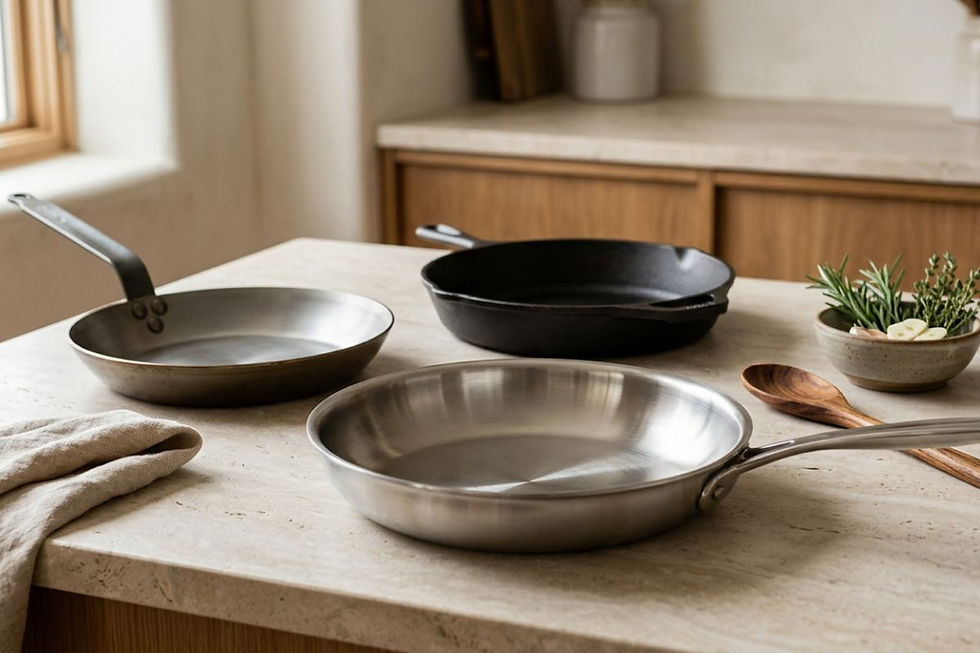
Still deciding between a full set and a single pan?
Many people find that upgrading just one high-quality frying pan covers most everyday cooking needs — without replacing everything at once.

Coated vs Uncoated Cookware: The Decision That Matters Most
The most useful way to narrow this lineup is not by brand. It is by asking whether you want your cookware’s easiest-release behavior to come from a coating or from the way you cook on an uncoated or coating-free surface.
Ceramic-coated
|
Coating-free textured titanium
|
Enameled cast iron
|
Hybrid coated
|
A useful cookware set should match how you actually cook. Our oil smoke points and cooking heat guide shows which materials and oils fit sautéing, searing, stir-frying, baking, and lower-heat cooking.
If you are still deciding between the most common everyday surfaces, our Ceramic vs Nonstick vs Stainless Steel comparison goes deeper into how those materials behave.
Cookware Materials: What Changes in Real Use?
Stainless Steel
Stainless steel dominates the top of this guide because it combines an uncoated food-contact surface with broad cooking versatility. Fully clad stainless uses a conductive core—usually aluminum—between stainless layers, so the pan heats more evenly than a simple single-wall stainless vessel. Its biggest advantages are recoverability and range: a stained or sticky stainless pan can usually be cleaned and brought back into service without depending on a nonstick layer remaining intact.
The tradeoff is technique. Stainless rewards preheating, enough fat, and patience before flipping food. It is also not literally inert in every possible context; composition and food chemistry matter, particularly for people with specific sensitivities. For the deeper science behind food, heat, and cookware materials, see our cookware leaching explainer.
Ceramic-Coated Cookware
Most “ceramic cookware” in commercial nonstick sets is metal cookware with a ceramic-based nonstick coating, not a solid ceramic pot. Its main advantage is convenience: low-stick cooking and easy cleanup without relying on a PTFE-based surface when the brand’s current formulation supports that claim.
The important ownership question is how long the release performance stays where you want it. Lower heat, gentle utensils, and non-abrasive cleaning can help, but ceramic coatings remain wear surfaces. That does not make them automatically unsafe as they age; it means their cooking performance and replacement value need to be judged differently from uncoated metal.
Titanium and Titanium-Treated Surfaces
“Titanium cookware” can describe very different systems. Our Place Titanium Pro uses a textured titanium cooking surface designed to create easier release without a conventional applied nonstick coating. Hestan NanoBond uses a titanium treatment bonded to stainless steel, behaving more like a premium metal cooking surface than nonstick. Those two products should not be treated as interchangeable simply because both use the word titanium.
Enameled Cast Iron
Enamel is a fused glass-like coating over cast iron. It removes the seasoning routine of bare cast iron and is well suited to braising, stews, bread, and long oven cooking. Its drawbacks are physical rather than subtle: it is heavy, responds slowly to temperature changes, and can chip if knocked hard enough.
If you are considering enamel specifically, our guide to enameled cast iron cookware covers the material in more depth.
Hybrid Cookware
Hybrid cookware deliberately mixes exposed metal and coating. HexClad's current TerraBond design uses raised stainless ridges with coated valleys, so it can brown more aggressively than a fully coated pan while remaining easier to clean than smooth stainless. The tradeoff is that you still own a coating-dependent surface, just one with a different architecture.
What Makes a Cookware Set Worth Buying?
The advertised piece count is one of the easiest cookware numbers to misread. A “12-piece” set does not necessarily contain 12 pots and pans. Lids, utensils, trivets, storage racks, and inserts are commonly counted too.
That is why our 2026 scoring gives 15% of PVS to Set Composition & Practicality. We care more about whether the set gives you complementary cooking vessels than whether the box carries a large number. All-Clad's 10 pieces translate to six cooking vessels plus four lids. GreenPan's 11-piece set gives you seven cooking vessels plus lids. Our Place's 10-piece Titanium Pro system centers on four cookware vessels, which makes it compact and efficient but not as broad.
A good full set usually covers several distinct jobs: frying, saucepan work, sautéing, and a larger stockpot or Dutch-oven-style vessel. Beyond that, extra pieces only add value if you will actually use them.
If you are replacing just one pan rather than building a full collection, you may be better served by our Best Non-Toxic Frying Pans, Best Saucepans, or Best Woks.
How to Choose the Right Non-Toxic Cookware Set
Start with how you cook, not with a materials slogan. If you sear, deglaze, move pans into the oven, and do not mind learning temperature control, stainless gives you the widest range. If breakfast foods and low-stick cleanup dominate your routine, ceramic-coated cookware may make daily cooking easier. If you want something between those two experiences, Our Place and HexClad are the most distinctive alternatives in this lineup.
Next, decide how much surface maintenance you are comfortable with. Uncoated stainless can be scrubbed and restored, but it asks more from your technique. Ceramic coatings ask less during cooking but more restraint in heat and cleaning if you want to preserve easy release. Enamel is durable in a different way: it does not need seasoning, but physical chips and the weight of cast iron are real considerations.
Then look at set breadth. A smaller collection can be ideal in a compact kitchen, while a six- or seven-vessel system is better if you are replacing most of your cookware at once. The best value set is not necessarily the cheapest; it is the one that gives you the pieces you will actually use without creating a replacement cycle you already know you dislike.
Finally, treat induction as a qualifier rather than the main material decision. Every final pick in this guide is induction compatible, but if induction performance, base design, flatness, and cooktop behavior are your primary constraints, go directly to our Best Induction Cookware Sets.

Care & Longevity by Surface Type
Cookware lasts longer when the care routine matches the surface. For stainless steel, avoid assuming every discoloration is damage: many heat tints, mineral spots, and stuck-on residues can be cleaned. Preheating gradually and avoiding severe thermal shock also helps reduce warping risk.
For ceramic-coated cookware, lower-to-medium heat and gentler utensils are usually the better long-term strategy. The goal is not to prove a fixed lifespan; it is to reduce unnecessary wear on the easy-release surface.
For coating-free textured titanium and titanium-bonded metal, follow the manufacturer-specific preheating and cleaning instructions rather than assuming all titanium systems behave the same way. Our Place and Hestan use fundamentally different surface technologies.
For enameled cast iron, avoid hard impacts and extreme thermal shock. Enamel does not need seasoning, but chipped enamel is not something you repair like a stained stainless pan. For hybrid coated cookware, remember that exposed metal does not eliminate the need to protect the coated portions of the surface.
FAQ
What is the safest cookware material?
There is no single cookware material we can responsibly label universally 'safest' for everyone. We look instead at the exact food-contact surface, coating disclosure where relevant, product condition, heat and care requirements, durability, and the way you actually cook. Uncoated stainless is attractive for durability and recoverability; ceramic-coated cookware prioritizes easy release; enamel and alternative metal surfaces solve different needs.
Is stainless steel or ceramic cookware better?
Stainless steel is usually the better fit if you prioritize long ownership potential, high-heat versatility, and a surface that does not depend on a nonstick coating. Ceramic-coated cookware is usually easier for delicate foods and cleanup, but the release performance is more dependent on coating condition and care.
What does PFAS-free cookware mean?
PFAS is a large family of fluorinated chemicals. A broad PFAS-free claim is more informative than a PFOA-free claim alone, but we still check the exact current product formulation and the strength of the evidence behind the wording. We do not assume every 'non-toxic' or 'eco' coating is PFAS-free without a specific disclosure.
Does PFOA-free mean PFAS-free?
No. PFOA is one PFAS. A product can be marketed as PFOA-free without that statement telling you whether other PFAS or PTFE are present. That is why our comparison tracks PFAS/PTFE wording separately rather than treating PFOA-free as a complete answer.
Is ceramic cookware non-toxic?
Most ceramic cookware in this category is ceramic-coated metal cookware. The useful question is not the word 'ceramic' by itself, but what the coating is, what the manufacturer currently discloses about PFAS/PTFE, how the surface is designed to be used, and how it holds up over time.
What cookware does not use a conventional nonstick coating?
Uncoated stainless-steel sets such as All-Clad D3 and Cuisinart MultiClad Pro do not rely on a conventional nonstick coating. Our Place Titanium Pro uses a coating-free textured titanium surface, while Hestan NanoBond uses a titanium treatment bonded to stainless steel. Enameled cast iron does have a fused enamel coating, so it should not be described as uncoated.
Are non-toxic cookware sets compatible with induction?
Many are. All seven final picks in this guide are induction compatible, but compatibility alone does not tell you how well a set performs on induction. If induction is your primary buying constraint, compare our dedicated induction cookware guide.
Is enameled cast iron a good cookware material?
It is an excellent specialist material for braising, stews, baking, roasting, and heat retention. The tradeoffs are weight, slower temperature response, premium pricing, and the need to protect the enamel from hard impacts. It is not the best universal replacement for lightweight everyday skillets and saucepans.
Final Recommendation
If you want one recommendation that works for the broadest range of kitchens, All-Clad D3 is our Best Overall. Its uncoated stainless surface, useful six-vessel core, mature evidence base, and cooking versatility make it the most balanced complete set we evaluated.
But the better choice can change with your priorities. GreenPan Valencia Pro is easier for low-stick everyday cooking. Cuisinart MultiClad Pro is the strongest value route into clad stainless. Our Place Titanium Pro is the most interesting coating-free easy-release alternative. Hestan NanoBond is the premium technical pick, Le Creuset is the slow-cooking specialist, and HexClad TerraBond is the hybrid option.
The most useful takeaway is simple: do not choose cookware based on a “non-toxic” label alone. Choose the food-contact surface, care routine, useful pieces, and ownership tradeoffs you can actually live with.
Stay in the Loop
Get practical guides on cookware materials, durable products, and conscious kitchen upgrades. No hype, no perfectionism—just clearer buying decisions and useful updates.
Related Guides
Strengthen your kitchen with these essentials:
About our editorial process
Zenda Guide reviews are produced by our Editorial Board using a documented methodology focused on durability, materials, and long-term value. Learn more about our Editorial Standards and Zenda Lab Protocol




Comments